Ion Implantation and Synthesis of Materials
Chapter 5: Ion Stopping

5.1 Introduction

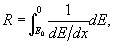
When an energetic ion penetrates a solid, it undergoes a series of collisions with the atoms and electrons in the target. In these collisions the incident particle loses energy at a rate of d E/d x of a few to 100 eV nm -1, depending on the energy, mass, and atomic number of the ion as well as on the mass, atomic number, and density of the substrate material. The energy-loss mechanisms are discussed in the next section, as we are concerned here with the penetration depth, or range, R, of the ions (Fig. 3.1). The range R is determined by the rate of energy-loss along the path of the ion

(5.1)

where E 0 is the incident energy of the ion as it penetrates the solid. The sign of d E/d x is negative, as it represents the energy- loss per increment of path, although tabulated values are given as positive quantities.

The main parameters governing the range or energy-loss rate are the energy, E 0, and atomic number, Z 1, of the ion and the atomic number, Z 2, of the substrate if we exclude the effect of the orientation of the crystal lattice. As the incident ion penetrates the solid, undergoing collisions with atoms and electrons, the distance traveled between collisions and the amount of energy lost per collision are random processes. Hence all ions of a given type and incident energy do...

UNLIMITED FREE
ACCESS
TO THE WORLD'S BEST IDEAS

SUBMIT
Already a GlobalSpec user? Log in.

This is embarrasing...

An error occurred while processing the form. Please try again in a few minutes.

Customize Your GlobalSpec Experience

Category: Mass Spectrometers
Finish!
Privacy Policy

This is embarrasing...

An error occurred while processing the form. Please try again in a few minutes.