Ion Implantation and Synthesis of Materials
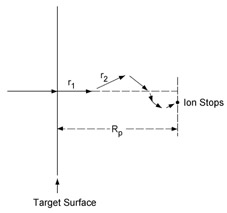
In ion beam modification of materials, the energetic ions interact with the solid through atom interatomic potential. These interactions are the basis of the development of expressions for ion range and ion damage in solids. Consider the passage of an energetic ion in a solid during an ion implantation experiment (Fig. 3.1). As the ion travels through the solid, it undergoes collisions with the stationary target atoms, which deflect the ion from its initial direction. The ion also collides with electrons in the solid and loses energy in these collisions. The major changes in its flight direction are due to the ion's collision with individual lattice atoms. This chapter will focus on two-body collisions, or binary collisions, involving energetic ions and target atoms.
The simplest collision event is the collision between a charged particle and the atomic nucleus. This can be treated as a two-body collision provided that the mean free path between collisions is much greater than the interatomic spacing. The chance of correlated effects, due to neighboring atoms recoiling simultaneously, is then very small. The momentum of the recoiling target atoms is the parameter that determines the amount of damage that occurs in the solid target.