Ion Implantation and Synthesis of Materials

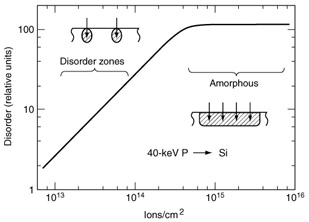
During ion implantation, each ion produces a region of disorder around the ion track. As the implantation dose increases, the disorder increases until all the atoms have been displaced and an amorphous layer is produced over a depth R p. The buildup and saturation of disorder are shown in Fig. 10.1 for 40 keV phosphorus ions incident on Si. In this example, about 4 10 14 phosphorus ions cm -2 are required to form an amorphous layer. Except for low doses or implantation with light ions, we can anticipate that an amorphous layer is formed during the implantation process. This assumes that no recovery of lattice order occurs around the ion track.
Amorphous regions also can be formed by light ion implantation at suitable target temperatures and doses. For light ion implantation the defect density in the single collision cascade is quite low, and amorphization occurs when the material accumulates enough damage that it reaches a critical threshold in the defect density (Rimini 1995). In general, for light ion amorphization, cascade overlap is required and the layer becomes amorphous when the free energy of the cascade-induced defect-rich region equals the free energy of the amorphous phase.
In terms of energy deposition, it has been found that amorphous formation requires an energy deposition of 6 10 23