Ion Implantation and Synthesis of Materials
Increasing beam currents through improvements in beam transport is only part of the solution for improving productivity. The other part is to minimize the time the beam spends off the water, characterized as beam utilization. We present here a treatment of utilization, developed by Brown et al. (2004). We then include a categorization of implanters commercialized over the last 35 years, in terms of beam type and scanning mechanism and the implication of each implanter's architecture on beam utilization.
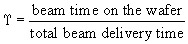
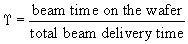
A general working definition of beam utilization is the ratio of beam time on the wafer to total beam time:
| (15.1) | |
where ? represents the beam utilization. Often, however, it is more convenient to express the beam utilization as a ratio of areas, or:
| (15.2) | |
The effective areas must of course accurately represent the times in (15.1). The beam utilization is critically dependent on the particulars of the implanter, such as beam type (spot or ribbon), endstation type (single or multiwafer) and scan mechanism (mechanical, electric, magnetic, or hybrid). Expressions are developed below for three different types of endstations and scanning mechanisms in use today.
This type of multiwafer endstation (13 17 wafers per disk, for 150 300 mm wafer sizes), is typically implemented on high current and high energy implanters. A spinning disk provides two-dimensional mechanical scanning (one rotation and one linear translation) of the wafers across the fixed spot...