Ion Implantation and Synthesis of Materials
Chapter 8: Channeling

8.1 Introduction

All theories examined earlier concerning the ranges of ions and radiation damage of materials were based on the assumption that the stopping medium is disordered, i.e., amorphous. In practice, we are dealing with polycrystalline or monocrystalline substances. The main parameters determining the range of an ion are its energy, E, its atomic number, Z 1, and the atomic number of the substrate, Z 2. In the case of single crystals, the orientation of the substrate and the vibrational amplitude (i.e., temperature) of the lattice atoms are also important parameters.

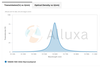
With single-crystal substrates of Si or GaAs, for example, the orientation of the ion beam with respect to the crystallographic axes of the substrate can have a pronounced effect on the range distribution. Figure 8.1 shows the range distribution in Si for 100 keV As implanted with the beam aligned parallel to the ?100 ? crystal axis (solid line) and oriented away from any crystal axes or planes (dashed line). As is evident in the figure, implantation along crystal axes can lead to a fraction of the total number of ions that penetrate several times R p.


Figure 8.1: Range distributions for channeled ion implanted along the ?100 ? axis of Si. The dashed line shows the Gaussian distribution for incident ions aligned away from any channeling direction

The crystal orientation influence on ion penetration is called channeling or the channeling effect. When an ion trajectory is aligned along...

UNLIMITED FREE
ACCESS
TO THE WORLD'S BEST IDEAS

SUBMIT
Already a GlobalSpec user? Log in.

This is embarrasing...

An error occurred while processing the form. Please try again in a few minutes.

Customize Your GlobalSpec Experience

Category: Circular Polarizers
Finish!
Privacy Policy

This is embarrasing...

An error occurred while processing the form. Please try again in a few minutes.