Itanium Architecture for Software Developers

This unique description of the Intel Itanium application architecture helps the software development community to use the power of Intel s new line of 64-bit processors.
 TABLE OF CONTENTS
 Chapter 3 introduced the application registers of the Itanium processor. At that time, we did not cover the registers that are provided to support the floating-point architecture. The registers that are used during floating-point operations are those in the floating-point register file, the floating-point status register, and control bits in the user mask. This section describes each of these register resources, their function, and instructions that affect their operation.
The registers in the floating-point register file are used to hold source and destination operands for floating-point computations. Figure 9.1 shows the structure of the floating-point register file. Notice that it contains 128 independent floating-point registers, which are labeled Fr 0 through Fr 127. Each of these registers is 82 bits wide. The large floating-point register file reduces the number of load and store operations in applications and results in increased floating-point performance. Programs at all privilege levels can access data in the floating-point registers.
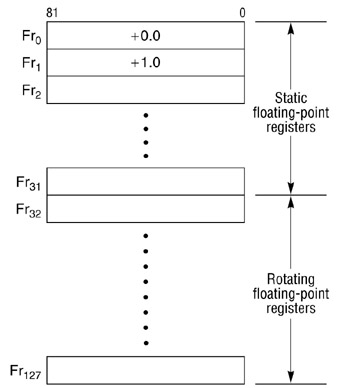
Similar to the general register file, the floating-point register file is organized into two partitions. In this case, they are called the static registers and rotating registers. Registers Fr 0 through Fr 31 are used for the static part of the floating-point register file. Fr 0 and Fr 1 have fixed values, and when accessed as a source operand, their values are always read as +0.0 and +1.0, respectively. If either of these registers is used...