Marks' Standard Handbook for Mechanical Engineering

BY
T. L. HENSHAW Consulting Engineer, Battle Creek, MI.
IGOR J. KARASSIK Late Senior Consulting Engineer, Ingersoll-Dresser Pump Co.
JAMES L. BOWMAN Senior Engineering Consultant, Rotary-Reciprocating Compressor Division, Ingersoll-Rand Co.
BENJAMIN B. DAYTON Consulting Physicist, East Flat Rock, NC.
ROBERT JORGENSEN Engineering Consultant.
by T. L. Henshaw
REFERENCES: Buse, Positive-Displacement Pumps, Marks Handbook, 9th ed., McGraw-Hill. Henshaw, Reciprocating Pumps, Van Nostrand Reinhold. Hydraulic Institute Standards, 14 ed., Hydraulic Institute. Chesney, Water Injection Pump Development, paper 68-Pet-11, ASME. Lees, Designing for High Pressures, paper 93-DE-9, ASME. Positive Displacement Pumps Reciprocating, API Standard 674, American Petroleum Institute.
Much of the text and some of the illustrations are from the author s book: Henshaw, Reciprocating Pumps, Van Nostrand Reinhold, 1987.
A displacement pump (also called positive-displacement, or just p-d) is a pump which imparts energy to the pumpage (the material pumped) by trapping a fixed volume at suction (inlet) conditions, compressing it to discharge pressure, then pushing it into the discharge (outlet) line. A displacement pump does not rely on velocity to achieve pumping action, as does a centrifugal pump or ejector.
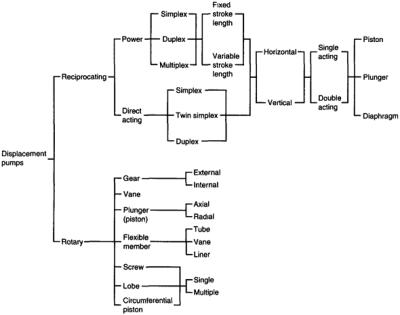
Displacement pumps fall into two major classes: reciprocating and rotary, as illustrated in Fig. 14.1.1.
Displacement pumps serve primarily in applications of low capacity and high pressure, those mostly beyond the capabilities of centrifugal pumps. Some of these services could be performed by centrifugals, but not without an increase in power requirements...