Mechanical Engineering License Review, Fifth Edition
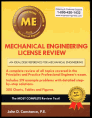
In 20 chapters, this volume covers the content of the national Mechanical Engineering License Review examination used in all 50 states.
 TABLE OF CONTENTS
 The natural flow of heat from a hot body to a cold body will be rapid if the difference in temperature is great, if the cooling or heating surface is large, and if the resistance to heat flow is small. When these conditions are not favorable, the flow will be correspondingly slow. We know that heat will not flow from a cold to a hot body, nor between bodies of equal temperature.
Refrigeration has to do with the artificial means for removing heat when conditions are unfavorable to natural or rapid flow. It has to do not only with producing low temperatures where desired, but also with accelerating the natural flow of heat at normal temperatures. Refrigeration is accomplished by providing a substance that is colder than the substance to be refrigerated.
Many liquids boil at temperatures low enough for refrigeration, but comparatively few are suitable for refrigeration purposes. Those which have practical usefulness are called refrigerants. The boiling points of some of the more important refrigerants at atmospheric pressure are given in Table 16-1. Increased pressure on any of these liquids raises its boiling point. Decreased pressure has the reverse effect upon the refrigerant and lowers the boiling temperature. The term "boiling point" is generally understood to mean the temperature at which vaporization takes place under atmospheric pressure at sea level. In this presentation the term "boiling temperature" will be used in referring to temperatures of vaporization at other pressures than atmospheric. The candidate for...