Mechanical Engineering License Review, Fifth Edition
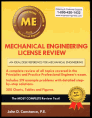
In 20 chapters, this volume covers the content of the national Mechanical Engineering License Review examination used in all 50 states.
 TABLE OF CONTENTS
 | P-1 | Liquid ammonia expands from a tank at 180.6 psia and 90 F in an evaporating coil and is then compressed. The compressor suction is 4.3 psi below atmospheric pressure. What is the refrigerating effect per pound of ammonia? |
|
| P-2 | An ammonia refrigeration unit has an 180-rpm, double-acting compressor whose cylinder has a diameter of 8 in. with a 10-in. stroke and whose clearance is 5 per cent. It is desired to calculate the refrigeration capacity in tons of refrigeration at an evaporation temperature of 12 F and a condensing temperature of 105 F. Assume that the 12 F vapor is saturated as it enters the compressor. Also assume that the liquid ammonia is not subcooled at the entrance to the expansion valve. |
|
| P-3 | Ammonia enters the cooler of an ammonia refrigerating machine at 0 F and leaves it at 15 F. When operating at 10 tons of refrigeration (ice melting capacity) and 15 indicated horsepower at the compressor, how many gallons per minute of condensing water must be supplied for a temperature rise from 50 F at entrance to 70 F at condenser exit. Assuming the liquid ammonia to leave the condenser at 50 F, calculate the ideal coefficient of performance. What is the actual coefficient of performance? |
|
| P-4 | In a test on an ammonia refrigerating machine 30 gpm of water are collected at the condenser outlet. For the same period the water enters the condenser at 70 F and leaves at 85 F. Assume "28 gal-deg per ton of refrigeration," what is the system capacity? |
|
| P-5 |