Mechanical Engineering License Review, Fifth Edition
In 20 chapters, this volume covers the content of the national Mechanical Engineering License Review examination used in all 50 states.
 TABLE OF CONTENTS
 | N-1 | The characteristic and horsepower curves shown in Fig. N-1 indicate the performance of a double-inlet forced-draft fan operating at sea level with a speed of 1,180 rpm when handling air at 40 F. Determine the static pressure developed by the fan and the power required to drive it when it handles 514,000 lb per hr of 80 F air at an altitude of 5,000 ft, where the barometric pressure is approximately 24.9 in. Hg abs. 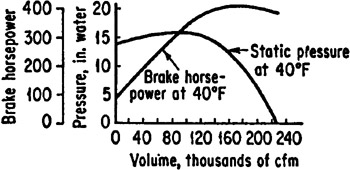 Figure N-1 |
| ||
| N-2 |
|
| ||
| N-3 | Characteristic curves in Fig. N-4 are for a forced-draft fan operated at speeds of 1,200 and 900 rpm. Also shown is the efficiency curve obtained at an operating speed of 1,200 rpm. Estimate the horsepower required to drive the fan when operated at a speed of 900 rpm and at a flow rate of 300,000 cfm at 15 in. water static pressure. 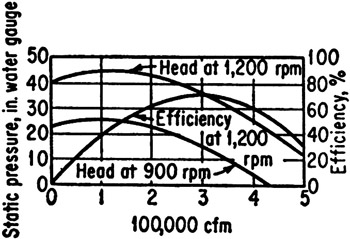 Figure N-4 |
| ||
| N-4 | The performance characteristics of a centrifugal compressor are shown in Fig. N-5; symbols are defined as follows:
|