Mechanical Engineering License Review, Fifth Edition
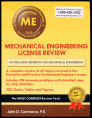
In 20 chapters, this volume covers the content of the national Mechanical Engineering License Review examination used in all 50 states.
 TABLE OF CONTENTS
 The water vapor present in the atmosphere is usually in the form of superheated steam as an invisible gas. The air is then "clear." If the atmosphere is cooled below the dew point, the excess vapor is condensed our in the form of minute drops of water or crystals of ice, so minute at first that they float as fog or cloud. If the droplets coalesce to form large drops, they fall to earth as rain. The maximum water vapor which can be held in the atmosphere increases greatly as the temperature is increased. At any temperature and pressure the quantity of water vapor can vary practically from none to maximum amount for that temperature. Absolute or "bone dry" air is never found in nature, but the amount of water vapor may be so low that it is difficult to measure it.
For practical air-conditioning purposes, it is frequently assumed that air and water vapor in the atmosphere follow the general gas equation for ideal gases, and that their mixture obeys Dalton's law of partial pressures.
To determine the maximum per cent of water vapor for gauge pressure:

Gauge pressure in denominator is for the entire system. Actual per cent of water vapor by volume is

| Q18-1 | Find the mass of air contained in a room 25 by 30 by 10 ft at atmospheric pressure and 65 F. |
|
| Q18-2 | Find relative humidity of air at 80 F dry bulb and 60 F. |
|
| Q18-3 | The temperature in a room is... |