The drain current expressions of the previous chapter were deduced assuming steady-state (dc) operation. In most circuits the terminal voltages of the device, of course, vary over time. In dynamic operation, the charges stored in the device vary and (charging) currents flow into the device to build up the varying stored charges.
In this chapter we will calculate the stored charges and the terminal current under large-signal dynamic operation. We will analyze the part of the device between the source and drain enclosed in the broken-line rectangle of Fig. 5.1. This part is called the intrinsic transistor and is where the field effect occurs.
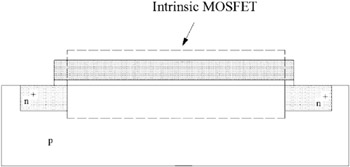 Fig. 5.1: MOS transistor structure showing the intrinsic part.
 The rest of the device, which includes the source- and drain-substrate junctions, and the overlap between the gate and the source and drain regions, is the extrinsic part of the transistor. The main objective of transistor modeling is to develop models of the intrinsic transistor. The extrinsic element ( e.g., junctions, capacitances) models are added afterwards to represent the effects of the extrinsic parts on transistor performance.
5.1 Transient Analysis of the MOS Transistor [1]
The development of accurate dynamic models of the MOS transistors has taken much longer than that of the bipolar transistor. For a while the distributed gate-channel capacitances were modeled by three lumped capacitances ( C gs , C gd , C gb) as proposed by Meyer [2]. Since the MOSFET is a four-terminal device, the three-capacitor model is inappropriate...
Copyright World Scientific Publishing Co. Pte. Ltd. 2007 under license agreement with Books24x7

 TABLE OF CONTENTS