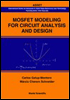
Mosfet Modeling for Circuit Analysis and Design
Appendix C: Drift-Diffusion Current Model

Overview

The motion of a carrier in a semiconductor is affected by the interaction of the carrier with the periodic crystal forces. This interaction is accounted for by the use of an effective mass, which differs from the free electron mass. The motion of electrons and holes in semiconductors can thus be approximately described by the effective mass approximation, which assumes that the electrons and holes behave as free particles where the influences of crystal forces are incorporated into this effective mass.

Electrons (and holes) have the thermal energy of classical free particles, that is, kT/2 for each degree of freedom, where k is the Boltzmann constant and T is the temperature in Kelvin.

For electrons (moving in three dimensions), the kinetic energy is


where v th is the thermal velocity and m n is the effective mass for free (conduction-band) electrons. For electrons in silicon at T=300 K, v th 10 7 cm/s.

A very simple model of carrier transport or current flow in semiconductors is obtained considering the carrier mean time between collisions (or mean scattering time) ? and the mean free-path l= v th ?. To simplify further, we consider transport in one dimension.

When a weak electric field F is applied to a semiconductor the carriers acquire a drift velocity v d added to their random (thermal) motion which is proportional to the applied field, the proportionality constant ? called the mobility. For...

UNLIMITED FREE
ACCESS
TO THE WORLD'S BEST IDEAS

SUBMIT
Already a GlobalSpec user? Log in.

This is embarrasing...

An error occurred while processing the form. Please try again in a few minutes.

Customize Your GlobalSpec Experience

Category: Schottky Diodes
Finish!
Privacy Policy

This is embarrasing...

An error occurred while processing the form. Please try again in a few minutes.