Mosfet Modeling for Circuit Analysis and Design

The outward flow, or flux, of a field through an element of surface is equal to the outward component of the field perpendicular to the surface times the area of the surface. Gauss law states that the flux of the electric displacement D flowing out of a closed surface is equal to the net charge Q enclosed within the surface:
For the cases of interest in this book, the relation between the electric field F and the electric displacement D is given by
where ? is the permittivity of the material, assumed to be a scalar.
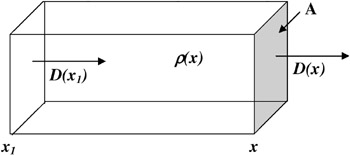
Let us consider in the case of a one-dimensional vector field a rectangular Gaussian box parallel to the field direction as shown in Fig. A1. Since the field runs parallel to the lateral sides of the box, there is no flux contribution from the lateral sides and Gauss law reduces to
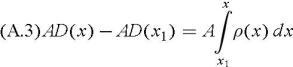
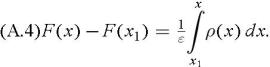
where A is the area of the lateral side of the box as indicated in Fig. A.1 and ? is the volumetric charge density. Considering a constant permittivity ? across the sample and canceling the common term A gives
Let us consider the case (common in bulk MOS modeling) where the electric field is zero in x 1.
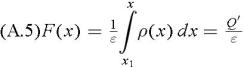
Equation (A.4) reduces to
where Q ? = Q /