Numerical Analysis Using MATLAB and Spreadsheets
This concise text provides complete, clear, and detailed explanations of the principal numerical analysis methods and well known functions used in science and engineering.
 TABLE OF CONTENTS
 For simplicity, we will only consider ODEs of order 2. Higher order ODEs are discussed in differential equations textbooks.
Consider the non-homogeneous ODE

where a, b, and c are real constants.
We have learned that the total (complete) solution consists of the summation of the natural and forced responses.
For the natural response, if y 1 and y 2 are any two solutions of (5.29), the linear combination y 3 = k 1y 1 + k 2y 2, where k 1 and k 2 are arbitrary constants, is also a solution, that is, if we know the two solutions, we can obtain the most general solution by forming the linear combination of y 1 and y 2. To be certain that there exist no other solutions, we examine the Wronskian Determinant defined below.
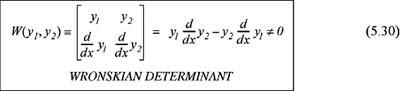
If (5.30) is true, we can be assured that all solutions of (5.29) are indeed the linear combination of y 1 and y 2.
The forced response is obtained by observation of the right side of the given ODE as it is illustrated by the examples that follow.
Find the total solution of the ODE

subject to the initial conditions y( 0) = 3 and y?( 0) = 4 where y? = dy/dt
Solution:
This is a homogeneous ODE and its total...