Numerical Analysis Using MATLAB and Spreadsheets

This concise text provides complete, clear, and detailed explanations of the principal numerical analysis methods and well known functions used in science and engineering.
 TABLE OF CONTENTS
 This chapter is an introduction to orthogonal functions. We begin with orthogonal lines and functions, orthogonal trajectories, orthogonal vectors, and we conclude with the factorization methods LU, Cholesky, QR, and singular value decomposition.
Orthogonal functions are those which are perpendicular to each other. Mutually orthogonal systems of curves and vectors are of particular importance in physical problems. From analytic geometry and elementary calculus we know that two lines are orthogonal if the product of their slopes is equal to minus one. This is shown in Figure 14.1.

Orthogonality applies also to curves. Figure 14.2 shows the angle between two curves C 1 and C 2.
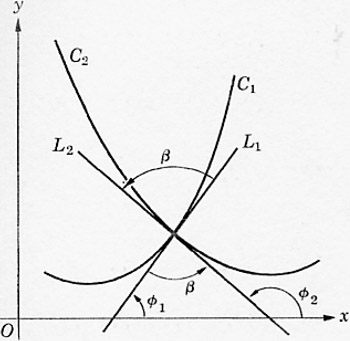
By definition, in Figure 14.2, the angle between the curves C 1 and C 2 is the angle ? between their tangent lines L 1 and L 2. If m 1 and m 2 are the slopes of these two lines, then, L 1 and L 2 are orthogonal if m 2 = ? 1/ m 1.
Prove that every curve of the family

is orthogonal to every curve of the family

Proof:
At a point P( x, y) on any curve of (14.1), the slope is

or

On any curve of (14,2) the slope is

or

From (14.3) and (14.4) we see that these two curves are orthogonal since their slopes are negative...