Numerical Analysis Using MATLAB and Spreadsheets
This concise text provides complete, clear, and detailed explanations of the principal numerical analysis methods and well known functions used in science and engineering.
 TABLE OF CONTENTS
Let A be an n n matrix, and I be the n n identity matrix. By definition, the eigenvalues ? i, i = 1,2,..., n of A are the roots of the nth order polynomial

We recall that expansion of a determinant produces a polynomial. The roots of the polynomial of (5.133) can be real (unequal or equal), or complex numbers.
Evaluation of the state transition matrix e At is based on the Cayley-Hamilton theorem. This theorem states that a matrix can be expressed as an ( n ? 1) th degree polynomial in terms of the matrix A as

where the coefficients a i are functions of the eigenvalues ?. We accept (5.134) without proving it. The proof can be found in Linear Algebra and Matrix Theory textbooks.
Since the coefficients a i are functions of the eigenvalues ?, we must consider the following cases:
Case I: Distinct Eigenvalues (Real or Complex)
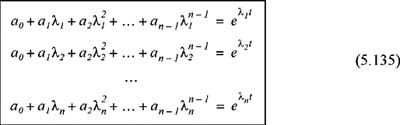
If ? 1 ? ? 2 ? ? 3 ?...? ? n, that is, if all eigenvalues of a given matrix A are distinct, the coefficients a i are found from the simultaneous solution of the following system of equations:
Compute the state transition matrix e At given that 
Solution:
We must first find the eigenvalues...