Numerical Analysis Using MATLAB and Spreadsheets
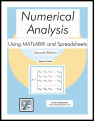
This concise text provides complete, clear, and detailed explanations of the principal numerical analysis methods and well known functions used in science and engineering.
 TABLE OF CONTENTS
 Consider the relation

where A is an n n matrix, X is a column vector, and ? is a scalar number. We can express this relation in matrix form as
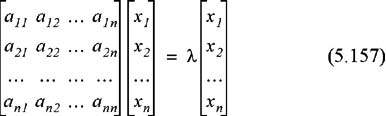
We write (5.157) as

or
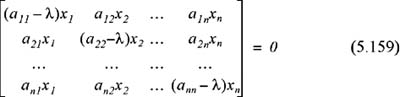
The equations of (5.159) will have non-trivial solutions if and only if its determinant is zero [*], that is, if
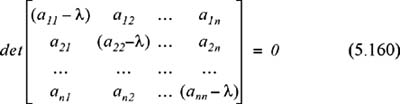
Expansion of the determinant of (5.160) results in a polynomial equation of degree n in ?, and it is called the characteristic equation.
We can express (5.73) in a compact form as

As we know, the roots ? of the characteristic equation are the eigenvalues of the matrix A, and corresponding to each eigenvalue ?, there is a non-trivial solution of the column vector X, i.e., X ? 0. This vector X is called eigenvector. Obviously, there is a different eigenvector for each eigenvalue. Eigenvectors are generally expressed as unit eigenvectors, that is, they are normalized to unit length. This is done by dividing each component of the eigenvector by the square root of the sum of the squares of their components, so that the sum of the squares of their components is equal to unity.
In many engineering applications the unit eigenvectors are chosen such that X X T = I where X T is the transpose of the eigenvector X, and I is the identity matrix.
Two vectors X