Numerical Analysis Using MATLAB and Spreadsheets
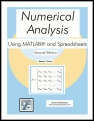
This concise text provides complete, clear, and detailed explanations of the principal numerical analysis methods and well known functions used in science and engineering.
 TABLE OF CONTENTS
 This chapter is an introduction to partial fraction expansion methods. In elementary algebra we learned how to combine fractions over a common denominator. Partial fraction expansion is the reverse process and splits a rational expression into a sum of fractions having simpler denominators.
The partial fraction expansion method is used extensively in integration and in finding the inverses of the Laplace, Fourier, and Z transforms. This method allows us to decompose a rational polynomial into smaller rational polynomials with simpler denominators, from which we can easily recognize their integrals or inverse transformations. In the subsequent discussion we will discuss the partial fraction expansion method and we will illustrate with several examples. We will also use the MATLAB residue(r,p,k) function which returns the residues (coefficients) r of a partial fraction expansion, the poles p and the direct terms k. There are no direct terms if the highest power of the numerator is less than that of the denominator.
Let

where N( s) and D( s) are polynomials and thus (12.1) can be expressed as

The coefficients a k and b k for k = 0, 1, 2, ..., n are real numbers and, for the present discussion, we have assumed that the highest power of N( s) is less than the highest power of D( s), i.e., m< n. In this case, F( s)...