Printed Circuits Handbook, Fifth Edition
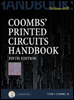
Clyde F. Coombs Jr.
Editor-In-Chief, Los Altos, California
Happy T. Holden
Westwood Associates, Loveland, Colorado
All electronic components must be interconnected and assembled to form a functional and operating system. The design and the manufacture of these interconnections have evolved into a separate discipline called electronic packaging. Since the early 1950s, the basic building block of electronic packaging is the printed wiring board (PWB), and it will remain that into the foreseeable future. This book outlines the basic design approaches and manufacturing processes needed to produce these PWBs.
This chapter outlines the basic considerations, the main choices, and the potential trade-offs that must be accounted for in the selection of the interconnection methods for electronic systems. Its main emphasis is on the analysis of potential effects that the selection of various printed wiring board types and design alternatives could have on the cost and performance of the complete electronic product.
[*] Adapted from Coombs, Clyde F. Jr., Printed Circuits Handbook (4th ed.), chap. 1, Electronic Packaging and Interconnectivity, (McGraw-Hill, New York, 1996.)
The continuing increase in component performance and lead density, along with the reduction in package sizes, has required that PWB technology find corresponding ways to increase the interconnection density of the substrate. With the introduction and continued refinement of such packaging techniques as the...