33.1 INTRODUCTION
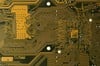
One of the major steps in the chemical processing of subtractive printed boards is etching, or removal of copper, to achieve the desired circuit patterns. Etching is also used for surface preparation with minimal metal removal (microetching) during innerlayer oxide coating and electroless or electrolytic plating. Technical, economic, and environmental needs for practical process control have brought about major improvements in etching techniques. Batch-type operations, with their variable etching rates and long downtimes, have been replaced completely with continuous, constant-etch-rate processes. In addition, the need for continuous processing has led to extensive automation along with complete, integrated systems.
The most common etching systems are based on alkaline ammonia and cupric chloride. Other systems include peroxide-sulfuric acid, persulfates, and ferric chloride. Process steps include resist stripping, precleaning, etching, neutralizing, water rinsing, and drying. This chapter describes the technology for etching high-quality, fine-line (0.003 to 0.005 in) circuits in high volume at a practical cost, as well as continuous processing, constant-etch rates, and control at high dissolved copper capacities. Increasingly, the production of uniform and constant feature geometries calls for precision and statistically robust control of the circuitization processes and materials.
There remains the ever increasing need to balance the process selection according to the factors of cost, environmental and regulatory compliance, stable factory productivity, low worker intervention requirements, compatibility with board design, and construction innovations. It is significant that environmental concern has eliminated the use of chromic-sulfuric acid and...

 TABLE OF CONTENTS