Printed Circuits Handbook, Fifth Edition

Dr. Hayao Nakahara
N.T. Information Ltd., Huntington, New York
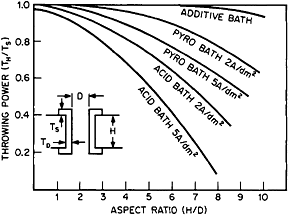
Fully electroless plating has been recognized as a viable technology for some time. It is especially useful for the formation of fineline conductors and considered excellent for plating small, high-aspect-ratio holes because of its high throwing power when compared with that of galvanic plating (see Fig. 31.1). However, its use was limited to the manufacture of doublesided and simple multilayer printed wiring boards (PWBs) for some time after the commercial introduction of the additive process called CC-4 began at Photocircuits Corporation in 1964. This was due to some relatively poor physical properties of electrolessly deposited copper, such as elongation of 2 to 4 percent, compared to 10 to 15 percent achieved by galvanically deposited copper.
The view on electroless plating technology began to change in the mid-1970s when IBM decided to utilize the technology for the fabrication of multilayer boards (MLBs) to package its then top-of-the-line mainframe computers.1 IBM and other PWB makers using fully electroless copper plating have continuously improved the properties of electrolessly deposited copper since the early 1980s. IBM has continued to use the technology for the fabrication of more advanced MLBs for mainframe and supercomputers.2 ,3 Stimulated by IBM s work, and because of technical necessity, NEC Corporation and Hitachi Ltd. of Japan also applied electroless plating technology for the fabrication of MLBs for their...