Printed Circuits Handbook, Fifth Edition
Hans Vandervelde
LCOA (Laminating Company ofAmerica),
Garden Grove, California
The purpose of through-hole drilling printed circuit boards is twofold: (1) to produce an opening through the board that will permit a subsequent process to form an electrical connection between top, bottom, and internal conductor pathways, and (2) to permit through-the-board component mounting with structural integrity and precision of location.
The quality of a hole drilled through a printed circuit board is measured by its ability to interface with the following processes: plating, soldering, and forming a highly reliable, non-degrading electrical and mechanical connection.
As with any process, the elements of the drilling process are:
Materials
Machines
Methods
Workers
When workers are properly trained and educated so that they possess a sound understanding of the other three elements, it is possible to drill holes meeting the aforementioned requirements with high productivity, consistency, and yield.
The goals of this chapter are as follows:
Understanding the drilling process thoroughly
Recognizing what might go wrong
Locating where problems could occur
Detecting whether problems do occur
Finding root causes of problems
Correcting undesirable conditions
Striving for zero discrepancies
Making improvement a team effort
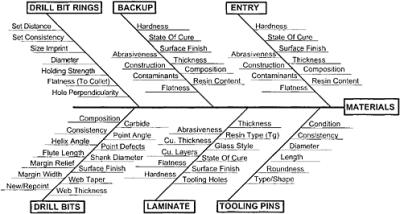
Materials that affect the drilling process are as follows and as shown in the fishbone diagram of Fig. 24.1.
Laminate material
Drill bits
Drill bit rings