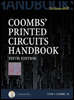
Printed Circuits Handbook, Fifth Edition
George Milad
Shipley Ronal, Inc., Marlborough, Massachusetts
Surface finish is about connectivity. It is at the surface where a connection from the board to a device is to occur. Initially soldering and insertion were the preferred methods for connecting components to the board and the board to the system. The dominant method of assembly was wave soldering. Hot-air solder leveling (HASL) was the finish of choice for component holes on the board. Electrolytic nickel/gold was used to plate the tabs for edge connectors.
The evolution from through-hole components to surface-mount components offered great opportunities to reduce the size and weight of the final electronic product. Surface-mount pads required screen pastes and reflow assembly. At its inception, surface mounting still fell within the capabilities of the HASL finish; however, as the need for further miniaturization continued, the surface-mount pad continued to shrink and screening paste on the pads became challenging. The HASL finish was not flat or coplanar enough for successful screening of paste on fine-pitch pads.
New designs required innovative solutions; ball grid arrays, wire-bonding pads, press fitting, and contact switches were all outside the traditional realm of HASL and electrolytic nickel/ gold. In addition, environmental concerns are being focused on the elimination of lead. This will change HASL from a process that uses a standard solder to a new lead-free process.
A series of surface finishes emerged to fill these needs. They include:
Organic solderability preservative (OSPs)
Electroless nickel/immersion gold...