Printed Circuits Handbook, Fifth Edition
Edward F. Duffek, Ph.D.
Adion Engineering Company, Cupertino, California
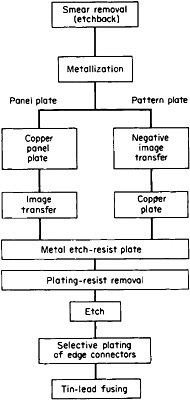
A major part of manufacturing printed circuit boards involves wet process chemistry. The plating aspects of wet chemistry include deposition of metals by electroless (metallization) and electrolytic (electroplating) processes. Topics to be described here are multilayer processing, electroless copper, direct metallization, electroplating of copper and resist metals, nickel and gold for edge connector (tips), tin-lead fusing, and alternative coatings. Specific operating conditions, process controls, and problems in each area will be reviewed in detail. The effects of plating on image transfer, strip and etching are also described in this chapter. See printed circuit plating flowchart in Fig. 28.1.
Two driving forces have had major influence on plating practices: the precise technical requirements of electronic products and the demands of environmental and safety compliance. Recent technical achievements in plating are evident in the capability to produce complex, high-resolution multilayer boards. These boards show narrow lines (3 to 6 mil), small holes (12 mil), surface-mount density, and high reliability. In plating, such precision has been made possible by the use of improved automatic, computer-controlled plating machines, instrumental techniques for analysis of organic and metallic additives, and the availability of controllable chemical processes. Mil-spec-quality boards are produced when the procedures given here are closely followed.
Process and equipment needs dictate the physical aspect of the facility and the character of the process, and vice versa. Some important items to consider...