Printed Circuits Handbook, Fifth Edition
Brian F. Conaghan, Ph.D.
Parelec Inc., Rocky Hill, New Jersey
Imaging is the process that patterns the metal conductor to form the circuit. This process involves a multistep integration of imaging materials, imaging equipment, and processing conditions with the metallization process to reproduce the master pattern on a substrate. Large features (200 m and greater) can be very economically formed by screen printing. Feature sizes smaller than 200 m, however, are formed using a photolithographic process, which is the main discussion of this chapter. As circuit densities have increased over the years, the imaging process has continually evolved to enable commercial production of finer features. This need for high-density interconnect (HDI) is driving the industry with feature sizes of 25 m or lower. Imaging equipment and materials have been developed to meet this challenge.
To achieve a reproducible high-yield/low-cost imaging process for a given feature size, various factors must be carefully balanced. This chapter outlines the chemistry and equipment options for the photolithographic imaging process, highlighting trade-offs that must be considered so that process engineers, designers, and procurers of printed wiring boards (PWBs) and HDI structures have an overview of the process considerations that can enable a manufacturable product. Screen printing will not be discussed. (For information on the screen printing process, Chap. 11 of the third edition of this handbook is recommended.1)
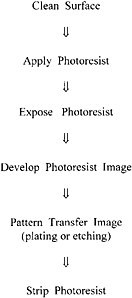
The photolithographic process sequence for imaging is given in Fig. 26.1. Basically the process involves applying a...