Printed Circuits Handbook, Fifth Edition
Dominique K. Numakura
DKN Research, Haverhill, Massachusetts
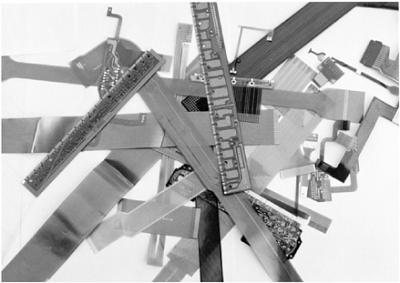
Flexible circuits are a form of printed wiring interconnect structure built on thin, flexible substrates. They are also bendable to complete 3-D (three dimensional) wiring that cannot be made by rigid circuit boards. Because of this flexibility, flexible circuits have many advantages compared to other wiring methods and they have many applications in electronic equipment that requires high-density wiring in a small space. As the samples in Fig. 56.1 show, most flexible circuits have cabling functions rather than mounting functions.
Tape automated bonding (TAB) has not been considered as a type of flexible circuit because of the slightly different manufacturing processes. However, the basic construction and materials of the final products are the same; therefore TAB is categorized as a type of flexible circuit in this book (see Fig. 56.2).
A thin flexible circuit generates many supplemental advantages not available with other wiring methods (Table 56.1). On the other hand, flexible circuits also have many disadvantages due to unstable thin constructions. It is necessary to consider how to avoid the disadvantages when a flexible circuit...