Signal Processing for Wireless Communications
Chapter 5: Performance Improvement Techniques

In this chapter we will build upon the topics previously discussed. Various modulation techniques were introduced followed by a presentation of different channel models. Demodulation techniques were also discussed and their corresponding performance curves were compared. In many applications the resulting system performance based on the above material is insufficient to provide a reliable communication link. Hence, in this chapter, we will present performance improvement techniques that would allow the system designer to be able to create a reliable communication system. We will begin by presenting Forward Error Correction (FEC) codes and their ability to improve performance. Next we will discuss antenna diversity techniques, both at the transmit and receive sides of the communication link. Lastly, we will apply these techniques and discuss the overall system gains in example link budget calculations.

5.1 FORWARD ERROR CORRECTION CODES

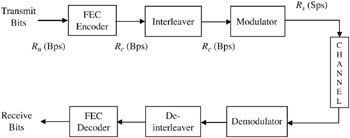
In this section we will discuss FEC codes. Here parity bits of information are inserted into the transmit data stream. The receiver makes use of these parity bits to better detect the data bits within a particular block or group of bits. A conventional-coded system block diagram is shown in Fig. 5.1 [1].


Figure 5.1: Coded communication system block diagram.

The raw information is introduced to the FEC encoder at an uncoded rate of R u bits/sec, this corresponds to the uncoded data rate. Since the encoder adds parity bits to the data bits, the encoded output data rate is given by R c bits/sec, with R c > R

UNLIMITED FREE
ACCESS
TO THE WORLD'S BEST IDEAS

SUBMIT
Already a GlobalSpec user? Log in.

This is embarrasing...

An error occurred while processing the form. Please try again in a few minutes.

Customize Your GlobalSpec Experience

Category: Error Correction Chips
Finish!
Privacy Policy

This is embarrasing...

An error occurred while processing the form. Please try again in a few minutes.