Signal Processing for Wireless Communications
In the previous subsections, we have considered an example of downlink and uplink spreading. These examples assumed a frequency flat fading channel; hence the receiver simply needed to calculate the propagation time delay
. In this subsection, we will discuss the FSF channel and its effects on the receiver architecture. For sake of discussion, we have decided to choose the downlink spreading example provided earlier. If we have a two-ray channel, then the received signal becomes
| (7.26) | |
We can generalize this to the following:
| (7.27) | |
where the index j is used to denote the receiver user of interest number, the index k is used to denote the multipath number, and the index i is used to denote the number of transmit users present. Here we see each user receives multiple signals or replicas of the same information that has traversed different propagation paths.
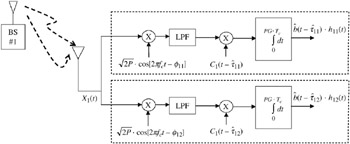
Generally speaking, a RAKE receiver has individual despreading functions called fingers [3]. One typically assigns a finger to each arriving multipath. An example of a two-finger RAKE for User 1 is shown in Fig. 7.14.
Above we have decided to have two entirely separate receiver chains to start a discussion on spectral down conversion. In practice, a single spectral down-conversion operation is needed for all the arriving multipaths. In doing so, a phase offset term is introduced since a single phase reference is used for all the arriving multipaths. In fact, this term...