Digital communication systems use some form of error rate as the figure of merit of how well the overall system is performing. This error rate can take on various forms such as bit error rate (BER), symbol error rate (SER), and frame error rate (FER). This chapter will present five error estimation techniques that can be used to evaluate system performance. We begin with the commonly used Monte Carlo (MC) technique, which essentially counts errors in the receiver. This technique makes no assumptions on the noise visible to the receiver, but can have a prohibitively long simulation run time when the BER of interest is extremely small. The estimation techniques that follow aim to reduce the long computer simulation run time.
The Conventional Importance Sampling (CIS) or Modified MC (MMC) techniques increase the likelihood that semirare events occur, thus reaching the expected error rate sooner, with our desired confidence level. This method was further enhanced with Improved Importance Sampling (IIS) which made those semirare events less rare. Next, the Tail Extrapolation (TE) technique, which makes certain assumptions regarding tail distributions, is used. Lastly, the Semi-Analytic (SA) technique, which combines both simulations and closed-form analytical solutions, is presented.
8.1 INTRODUCTION TO SIMULATION
Computer simulation has grown to become an integral part of the digital communication system design. Depending on the desired output, various degrees of system level abstractions exist that can be used in the performance investigations. A generic digital communication link is shown in Fig. 8.1.
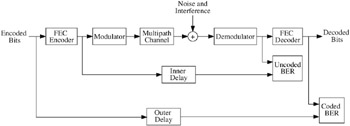 Figure 8.1: Typical digital...
Copyright The McGraw-Hill Companies 2008 under license agreement with Books24x7

 TABLE OF CONTENTS