Signal Processing for Wireless Communications
In this section, we will review the HSUPA operations. Here the UE monitors the downlink channels and then decides what uplink channels should be used to transmit to achieve higher uplink throughput. With HSDPA, the link data rates are higher in the downlink than in the uplink. HSUPA attempts to equalize the uplink and downlink throughput to provide somewhat more symmetrical data rates. The term used in 3GPP is enhanced dedicated channel or E-DCH using short notation.
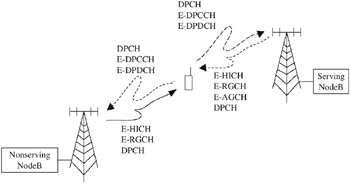
Similar techniques to HSDPA have been used by having fast uplink adaptation, scheduling, and multicodes transmission. The relevant operating channels are provided in the block diagram in Fig. 7.129. We have shown the UE communicating with two NodeBs, one declared as serving and the other as nonserving. Note this distinction is important since certain channels and functionality are assumed for serving and nonserving cells, as will be discussed later.
Like HSDPA, HSUPA supports multicode operation. On the other hand, unlike HSDPA, HSUPA supports limited higher-order modulation on the uplink (BPSK and 16-QAM). This is simply due to the fact that more modulation levels lead to higher peak-to-average power ratios which require higher back-off in the transmit power amplifier device. Similar to the HSDPA HARQ procedure, the HSUPA procedure is such that the NodeB will combine each physical retransmission until the packet is received correctly or the maximum number of retransmissions has been reached. The UE will schedule such packet transmissions.