Signal Processing for Wireless Communications

Chapter 7: 3G Wideband CDMA

In this chapter, we will discuss a spread spectrum multiple-access technique used for the third generation (3G) Digital Cellular System called wideband CDMA, also referred to as WCDMA. We begin with some examples of the 2G spread spectrum cellular system called IS-95. The purpose is to introduce key topics and issues surrounding CDMA systems in general. We move on to a discussion of Pseudorandom Noise (PN) code generation techniques as well as their properties. A short comparison will be made and applications will be discussed. Next, the RAKE receiver will be presented and used as our reference receiver. At this point, we will have developed a baseline understanding to prepare us for the rest of the chapter, where we discuss the WCDMA standard. We expand this discussion to include high-speed downlink packet access (HSDPA) and high-speed uplink packet access (HSUPA) features of the 3GPP standard.

7.1 INTRODUCTION

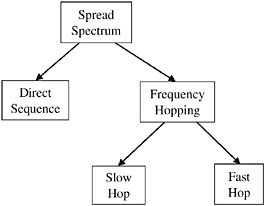
In a spread spectrum system, the narrowband information signal is transmitted over a larger bandwidth to overcome the multipath fading channel distortion discussed earlier in Chap. 3. In Fig. 7.1, we provide an overview of two types of spread spectrum techniques: Direct Sequence (DS) and Frequency Hopping (FH). This multiple-access scheme is used when all users have a PN sequence code that is ideally uncorrelated with that assigned to any other user occupying the same channel [1].


Figure 7.1: Spread spectrum categories.

Next we provide some general comments for each of the two techniques discussed above. First, the DS technique is greatly affected...

UNLIMITED FREE
ACCESS
TO THE WORLD'S BEST IDEAS

SUBMIT
Already a GlobalSpec user? Log in.

This is embarrasing...

An error occurred while processing the form. Please try again in a few minutes.

Customize Your GlobalSpec Experience

Category: Access Points
Finish!
Privacy Policy

This is embarrasing...

An error occurred while processing the form. Please try again in a few minutes.