Signal Processing for Wireless Communications
In this chapter we will discuss various receiver digital signal processing functions. We begin with a discussion of equalization methods available assuming a single spatial antenna receiver. Then continue with a presentation of space-time equalization where joint equalization and antenna combining is performed for the purposes of improved performance. Due to an increased interest in the wireless community of operating in the frequency domain, we present an overview of frequency domain equalization (FDE). We then move on to symbol timing recovery (STR), channel quality estimation (CQE), and automatic frequency control (AFC). We conclude the chapter with an overall receiver block diagram to put the above mentioned signal processing algorithms into perspective.
In channels with memory, such as multipath frequency selective fading channels, the received signal is composed of multiple-delayed versions (or echoes) of the transmitted signal. These delayed versions sum and subtract to result in Inter-Symbol Interference (ISI). This ISI cannot be eliminated by increasing the transmitter power or reducing the receiver noise figure. A method used to remove the ISI is through equalization. Equalizers make use of the time diversity of the received signal (as with RAKE receivers in CDMA systems) to extract the multiple-delayed echoes and form a combined symbol. Some commonly used methods are as follows:
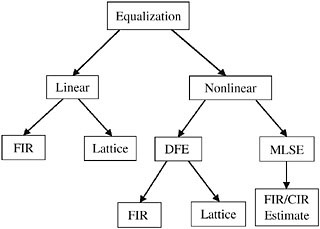
Linear equalization
Decision feedback equalization
Maximum likelihood sequential estimation
These methods are shown in Fig. 6.1, where an attempt to provide an outline has been made.
The equalizer...