Signal Processing for Wireless Communications
7.7: HIGH-SPEED DOWNLINK PACKET ACCESS (HSDPA) OVERVIEW

7.7 HIGH-SPEED DOWNLINK PACKET ACCESS (HSDPA) OVERVIEW

In this section, we will present an overview of this technique of providing packet services on the downlink. The important components/features of HSDPA are an increase in the downlink throughput and peak data rates, low-latency control, adaptive modulation and coding and physical layer retransmissions, fast channel adaptive scheduling, and dynamic resource sharing [23, 40 42].

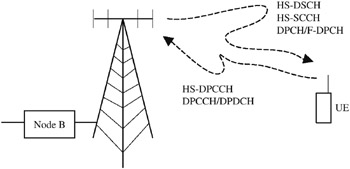
The physical channels required to support HSDPA are shown in Fig. 7.108, with HS-DSCH being high-speed downlink shared channel and HS-SCCH representing high-speed shared control channel. In order to support the low-latency control, smaller frame sizes have been used for 2-msec duration. Moreover, the scheduling operation has been moved from the RNC to the NodeB to provide quick turnaround response times.


Figure 7.108: HSDPA physical channels.

The basic HSDPA operation is as follows: The NodeB transmits packets of data at a high rate to the UE. The data rate highly depends on the UE capability, channel conditions, and NodeB capability. If the UE successfully receives them, then an ACK is transmitted and the NodeB continues to flush its data buffers. On the other hand, if a NACK is transmitted by the UE, then the NodeB will retransmit the packet with either the same information or additional information in order to help the UE successfully detect the packet of data.

The ACK/NACK information is carried in the uplink HS-DPCCH channel. In parallel to this loop, the UE is sending Channel Quality Indication (CQI) to the NodeB, giving the NodeB scheduler an ...

UNLIMITED FREE
ACCESS
TO THE WORLD'S BEST IDEAS

SUBMIT
Already a GlobalSpec user? Log in.

This is embarrasing...

An error occurred while processing the form. Please try again in a few minutes.

Customize Your GlobalSpec Experience

Category: IC Interfaces
Finish!
Privacy Policy

This is embarrasing...

An error occurred while processing the form. Please try again in a few minutes.