Signal Processing for Wireless Communications
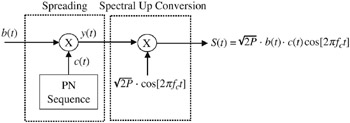
Let us consider a simple BPSK-based CDMA system. The transmitter example is given in Fig. 7.4, where the input data bits b( t) are multiplied by a chip sequence c( t), in order to produce the spectrally spread signal y( t). This spread signal is then spectrally up-converted to its allowed frequency band centered at a carrier frequency denoted by f c. The block diagram in Fig. 7.4 highlights the two operations performed at the transmitter, namely, spreading and spectral up-conversion.
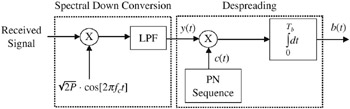
We can immediately draw the receiver architecture with the assumption of ideal carrier recovery, chip-time synchronization, and the knowledge of the actual PN chip sequence used at the transmitter. The receiver block diagram shown in Fig. 7.5 highlights the two operations performed at the receiver, namely, spectral down conversion and despreading.
The spectral down-conversion operation involves the multiplication of a sinusoid followed by the low-pass filter (LPF) to remove the unwanted spectral product. This baseband (ZIF) signal becomes despread by first multiplying by the PN chip sequence c( t) and then accumulating the chips across the SF interval. In this example, the SF interval is equivalent to the bit time duration.
In the above example, we assumed ideal coherent detection and perfect time synchronization of the PN sequences. More specifically, we assumed the locally generated oscillator used in the spectral down-conversion operation...