Spread Spectrum CDMA: IS-95 and IS-2000 for RF Communications
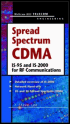
Provides a user-friendly explanation of the concepts, issues, and techniques behind the IS-95 and IS-2000 CDMA standards.
 TABLE OF CONTENTS
 Before we plunge headlong into the realm of spread sprectrum CDMA, we first begin by reviewing a few basic fundamentals, including the super hetrodyne receiver. A standard "super-heterodyne" RF receiver typically consists of the following basic functional blocks: a "front-end" RF preamplifier (vitally necessary, since the typical RF energy present at the antenna is extremely weak, on the order of microvolts per meter); a "mixer" (basically an amplifier designed to combine, or "mix" two inputs: the boosted RF signal from the antenna and a continuous sine wave produced by the next component); a Local Oscillator (LO, which does nothing more than generate a "pure" continuous sine wave output); an IF filter (tuned to pass signals only around the IF frequency and reject the LO, the RF and as many unwanted miscellaneous signals as possible); an IF amplifier (to boost the output from the mixer); a demodulator (to extract out the desired audio information from the IF signal); a low pass filter (which passes only audio frequencies); and an audio output circuit (e.g. amplifier and speaker). In the case of a digital receiver, most of the components are basically similar, with the exception of some form of a "decision" circuit which attempts to compare or correlate the noise-corrupted incoming waveform "symbol" with an ideal waveform, and may possibly have a wider bandwidth. The job of the correlating decision circuit is complicated by the presence in the environment of varying amounts of random noise; this tends to degrade...