Spread Spectrum CDMA: IS-95 and IS-2000 for RF Communications
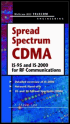
Provides a user-friendly explanation of the concepts, issues, and techniques behind the IS-95 and IS-2000 CDMA standards.
 TABLE OF CONTENTS
 If we were the only user on the system, then things would be fairly simple for our communications link, since we would not need to worry about restricting our output power to minimize co-channel interference to other users, or deal with the interference they would be inflicting on us. However, since we began this odyssey into the world of CDMA bit convolutions primarily to accommodate the ever growing population of RF users, we need to consider the effect that multiple users have on the system, as well as on each other.
In a typical cellular system, a town or city is covered by multiple base stations scattered roughly a few hundred meters to perhaps two or three kilometers apart (depending on the number of users in the area). Mobiles on the system are usually scattered various distances around a given base station, and are typically in motion, requiring the whole system to be in a constant state of dynamic adjustment. Since all users are on the same channel at the same time in our CDMA system, users who are a few hundred feet from the base station could easily drown out a user who is a mile away, resulting in either severe corruption to that distant user's incoming signal, or in masking it out entirely, creating a dropped call or denial of service. To prevent such a situation, the base station constantly sends power control commands to each user, automatically adjusting each mobile's output...