Spread Spectrum CDMA: IS-95 and IS-2000 for RF Communications
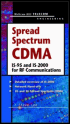
Provides a user-friendly explanation of the concepts, issues, and techniques behind the IS-95 and IS-2000 CDMA standards.
 TABLE OF CONTENTS
 A number of excellent books have been written on the subjects of Fourier analysis, superpositions, convolutions, and transforms, as well as on the "computer friendly" form known as the Fast Fourier Transform (FFT). We will recap some of the more significant highlights of Fourier mechanics here, but those who find these techniques intriguing would be well rewarded by spending time pursuing the topic more thoroughly at their local university library (see bibliography: Arfken, Brigham, etc.)
Fourier mechanics is the language of waves. Through it we can dissect or analyze anything that has (or can be portrayed to have) a wavelike nature. Propagating E&M waves are ideal candidates for this technique, but it can equally be exploited to analyze a system's band-pass, the components of a waveform, the molecules through which our E&M waves propagate, etc. The basic premise of Fourier superposition is that we can model any well-behaved signal or structure using a well-chosen set of orthogonal functions as our basic building block "basis" set. These can be a collection of sine wave harmonics (a fundamental frequency and multiples of that fundamental), or a similar set of cosines. Other possibilities include Bessel functions, spherical harmonics, Legendre polynomials, etc. (Arfken is a suitable source book to cover most of these functions.) At first glance, these functions may seem a bit intimidating, but no more so than the sine() or cosine() functions. We do such amazing things with them, that they have transcended the level of merely being useful...