Spread Spectrum CDMA: IS-95 and IS-2000 for RF Communications
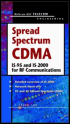
Provides a user-friendly explanation of the concepts, issues, and techniques behind the IS-95 and IS-2000 CDMA standards.
 TABLE OF CONTENTS
 Since the convolutional encoder enables us to recover one damaged bit when the adjacent bits are not damaged, and since noise spikes tend to be several bits wide, it is now essential for us to somehow separate these adjacent bits. To accomplish this, we "shuffle" all the bits around in a nonrandom way such that the resulting arrangement places two consecutive bits in our bit stream 10, 15, or 20+ bits apart, in order to prevent noise spikes from destroying several consecutive bits in our bit stream. In IS-95, we "Interleave" the bits, first writing them into a matrix by rows, and then reading them out by columns. The simplest way to illustrate this is to picture a simple matrix, like a calendar, so many columns across and so many rows deep. We fill up each space in our matrix one bit at a time, row by row across the matrix, the same way you would mark off the days on a typical wall calendar. Once we have filled up our matrix, we then send out the bits by running down the columns rather than across. As a result, instead of the bits going in order of 1,2,3,4,5,6,7 they now go out: 1,8,15,22,29,2,9,16,23,30,3,10,17 Here we used a 5-row x 7-column matrix for easy comparison to a calendar. An actual interleaver could use a 10 x 10, or a 100 x 100 matrix, etc. The larger the matrix, the wider we distribute adjacent bits. Obviously, there...