Spread Spectrum CDMA: IS-95 and IS-2000 for RF Communications
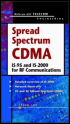
Provides a user-friendly explanation of the concepts, issues, and techniques behind the IS-95 and IS-2000 CDMA standards.
 TABLE OF CONTENTS
 So far, we have discussed the basic propagation of a signal through a fairly brutal environment, strewn with copious amounts of natural and manmade random (and not so random) noise. Throughout this world of noise, multipath, and band-limited choke points, we found our meek little pristine bit stream got more than its share of black eyes and skinned knees, particularly when more than one user felt the urge to communicate. In fact, if the much touted laws of thermodynamics are to be believed (and they are), not only can we not win this game and hope, even occasionally, to get out a better signal than what we started with (first law of thermodynamics), we can't even hope to break even (second law of thermodynamics, a.k.a. "the law of entropy"). In other words, the reality of thermodynamics tells us that our signal will only get worse once it is sent. The net effect of such signal degradation makes it much more difficult for our receiver to correctly reconstruct our original bit stream.
In the past, noise was viewed as "just a fact of life" you lived with it, and if it totally bludgeoned your bit stream somewhere out over Manhattan, or Ontario, or wherever, "well, what the heck, send it again," or worse yet "forget it; just send me a floppy." Unfortunately, when it comes to sending mission-critical information, pony expressing a floppy back and forth across the great beyond doesn't quite make the grade. When talking about Shuttle telemetry, or...