Spread Spectrum CDMA: IS-95 and IS-2000 for RF Communications
Provides a user-friendly explanation of the concepts, issues, and techniques behind the IS-95 and IS-2000 CDMA standards.
 TABLE OF CONTENTS
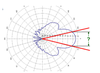
 Since our RF links routinely use antennas with multiple elements for increased gain and directivity (particularly at sectorized base station or actively lobed beams, as in IS-2000 applications), a brief overview of antenna gain theory seems appropriate. In considering such directional antennas, we will begin with a collection of identical radiating elements located randomly around our source transmitter. These are fed with variable amplitudes (A n) and phases (exp(i a n)), and located at random positions (r n). We will consider the electric field radiated by each of these elements with the understanding that the magnetic field is derivable from the electric field, and is typically several orders of magnitude weaker at distances beyond ~10 to 50 wavelengths (in the "far field" or Fraunhofer region). Using the same notation as in Appendix C (i.e., bold letters indicate a vector), our net electric field at our receiver located at 'r' due to this collection of radiating elements is:
E(r) =E 0 f (q,f) exp(+i k r)/(4 p r)
where f (q,f) describes the angular distribution of the field radiating from each of the individual radiating elements (which, for simplicity, we consider here to be identical). Since we are only considering the field strength at a point well away from the source (i.e., the far-field energy), the wavefronts from each element are nearly parallel by the time they arrive at our far-field location. We write the projection of each R n