Spread Spectrum CDMA: IS-95 and IS-2000 for RF Communications
Provides a user-friendly explanation of the concepts, issues, and techniques behind the IS-95 and IS-2000 CDMA standards.
 TABLE OF CONTENTS
 If you recall our comments on the topic of Fourier superposition, we discussed the use of certain orthogonal "basis" functions, like sin() and cos() and stated that they can be used to construct other functions like square waves, or an antenna radiation pattern, or to model an atom, etc. We said that there were many functions we could use, but they had to meet certain requirements, the primary requirement being that they must be "orthogonal," i.e., they must not "interact," or "co-mingle" with one another if combined in the same system. Equation 1.2 states this orthogonality in mathematical form for a basis set composed of sine waves. Since our bit stream is a simple binary pulse train, if we are clever enough, it is possible to construct a complete set of digital orthogonal basis functions such as IS-95's "Walsh codes," which are composed of nothing more than well placed 1's and 0's. Here too, the most important requirement in creating these digital basis functions is that each function in this set be orthogonal with all others in the set:
k=0 S N W j * W k = d (j, k) (3.2)
with: 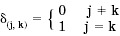
In Chapter 1 "Basic RF Concerns" we used a set of orthogonal functions to construct other more complicated waveforms. As it turns out, there are other useful applications for such a set of orthogonal functions. Specifically, when we convolve our bit stream with our digital orthogonal Walsh...