Spread Spectrum CDMA: IS-95 and IS-2000 for RF Communications
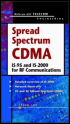
Provides a user-friendly explanation of the concepts, issues, and techniques behind the IS-95 and IS-2000 CDMA standards.
 TABLE OF CONTENTS
 In our studies of CDMA thus far, we have focused rather heavily on the coding, messaging and spreading aspects of the link, but made only vague gestures of acknowledgment to the core phenomenon of RF transport that forms an extremely essential part of the overall communications exchange. Since there can be no CDMA RF link without RF propagation, and since many in the field tend to view this aspect of the process as a vague, ethereal mystery, we include a few general highlights to help fill in some of the gaps. Since the study of electrodynamics has been around for over 150 years, those interested in greater detail will find more than enough advanced literature on the subject with very little effort (see Bibliography, Reitz et al. and Jackson). For our immediate needs however, the following overview should prove more than adequate.
Electrodynamics is the study of the effects of charges in motion (as opposed to electrostatics, the study of charges at rest). When a charge is stationary, we (or more correctly, other charges around it) sense only an electric field surrounding that charge. When a charge is put into motion (accelerated from rest), we know from experience that a magnetic field is created around it, to which other charges react. As mentioned in the body of the text, we can verify this by wrapping a wire around a toy compass, and running a current through the wire.
We begin our discussion on the subject by defining the magnitude...