Spread Spectrum CDMA: IS-95 and IS-2000 for RF Communications
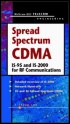
Provides a user-friendly explanation of the concepts, issues, and techniques behind the IS-95 and IS-2000 CDMA standards.
 TABLE OF CONTENTS
 One of the more fundamental questions that arise in most discussions on CDMA, revolves around the topic of system capacity, since it was the promise of a much larger capacity gain from CDMA over all other technologies that originally motivated our initial venturing into the complexity that is CDMA. Preliminary theoretical estimates tended to project an increase in capacity somewhere near a factor of 10 to 15 over AMPS. However, after IS-95 was deployed and data was taken on an actual live network, the capacity increase was found to be on the more modest side, running roughly around a factor of 4 to 6 over AMPS, depending on hand-off thresholds, FER thresholds, local propagation, cochannel interference, etc. Still, a quadrupling or better of system capacity is far more than can be provided by any other technology (including TDMA, which is either a break-even trade with AMPS or a slight deficit). Such an increase has done much to help absorb the dramatic rise in demand that has occurred in the last 5 to 10 years.
In the deployment of a CDMA system, there are several differing objectives that need to be balanced. For example, one application may have the primary requirement that the link be extremely robust with very low bit errors (e.g., remote telemetry for a NASA deep-space probe); another application may instead require an extremely high capacity which can accommodate thousands of users simultaneously (cellular service providers); while other implementations may demand stealth and a...