Mathematics is a universal language that has evolved over thousands of years. It draws on contributions from every civilization and corner of the world from the ancient worlds of the Middle East, Greece, and Rome, to India, China, Russia, Africa, and pre-Columbian Mayan culture.
Mathematics is used all over the world to solve problems in economics, engineering, manufacturing, construction, electronics, social science and myriad other disciplines. Through mathematics, people can communicate abstract ideas with each other even though they may speak different languages and may come from different cultures.
The language of mathematics consists of many dialects, or subdisciplines. These include arithmetic, algebra, geometry, trigonometry, and statistics, to name a few. This book concentrates on the rudimentary skills needed to study mathematics and solve practical problems encountered in technical fields.
1.1 Symbols The Alphabet of Mathematics
As with any language, mathematics has established rules and terminology. These are written with symbols a sort of mathematical alphabet that is used to construct complicated expressions and convey abstract concepts in a compact, unambiguous form. Unlike the English alphabet, which has twenty-six symbols, the mathematical language has numerous symbols and is not recited in any particular order.
Many common mathematical symbols are listed in Table 1.1. Become familiar with these symbols and refer to them throughout this book.
Table 1.1: Common Mathematical Symbols | Symbol | | Symbol | |
| + | Plus (sign of addition), or positive | ? | Union of sets |
| | Minus (sign of subtraction), or negative | ?, ? | |
Copyright Industrial Press Inc. 2006 under license agreement with Books24x7

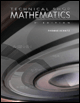
 TABLE OF CONTENTS