Technical Shop Mathematics, Third Edition

Chapter 21: Oblique Angle Trigonometry

Thus far our study of trigonometry has been limited to right triangles. Application of trigonometry to oblique triangles is studied in this chapter.

Oblique triangles are often encountered in shop problems. Distances between holes, lengths of sides, and angles between centerlines are usually indicated in the layout of machine parts. The oblique triangles formed by sides and centerlines may be solved by construction of right triangles on the obliques or by the use of special formulas given in this chapter.

Oblique triangles are triangles in which none of the angles are right angles. Acute oblique triangles have all angles less than 90 degrees. Obtuse oblique tri angles have one angle greater than 90 degrees.

21.1 Solving Oblique Triangles Using Right Triangles

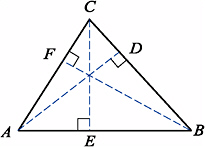
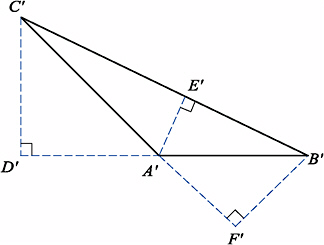
One way to solve a problem involving an oblique triangle is by reconfiguring the problem into one involving right triangles. Auxiliary lines are added to construct the necessary right triangles by dropping perpendiculars from angle vertices to their opposite sides. This construction is shown in Figure 21.1 for an acute oblique triangle and in Figure 21.2 for an obtuse oblique triangle. The resulting right triangles may then be solved by applying the rules for right angle trigonometry.


Figure 21.1: Right triangle construction in acute oblique triangles

Figure 21.2: Right triangle construction in obtuse oblique triangles

In the case of acute oblique triangles typified in Figure 21.1, the altitudes all fall within triangle ABC and six right triangles are formed: ADC and ADB; BFA

UNLIMITED FREE
ACCESS
TO THE WORLD'S BEST IDEAS

SUBMIT
Already a GlobalSpec user? Log in.

This is embarrasing...

An error occurred while processing the form. Please try again in a few minutes.

Customize Your GlobalSpec Experience

Category: Cutting Tool Inserts
Finish!
Privacy Policy

This is embarrasing...

An error occurred while processing the form. Please try again in a few minutes.