Technical Shop Mathematics, Third Edition
With properties and operations of real numbers in place, we proceed to the work of algebra: the study of the relationships among quantities, as represented by variables and constants in mathematical expressions and equations. Algebra provides algorithms that is, systematic methods for solving equations that model physical processes occurring in the shop, be it a factory, a garage, a welding site, a construction site, or a laboratory.
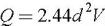
Technical shop mathematics largely entails applying a formula directly or rearranging a formula to solve for a particular unknown variable. However, before we can solve an equation we need to know how to perform the basic operations on algebraic expressions within the equation: the four arithmetic operations, powers and roots, and the processes of expanding and factoring an expression. For example, flow of fluid through a pipe is given by the formula
where the variables Q, d, and V represent flow in gallons per minute, diameter of pipe in inches, and velocity of flow in feet per second, respectively. The number 2.44 is a constant in the relationship.
Keep in mind that the properties of real numbers, such as the commutative property of multiplication, also apply to variable expressions.
Variable A variable is a value that is unknown or subject to change. Usually a variable is represented by a letter, such as x, y, z, s or t. The point of most algebra problems is...