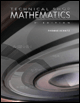
Technical Shop Mathematics, Third Edition
An axiom is a universally recognized statement whose truth is accepted without proof. For example, the claim that Jennifer cannot be in Virginia at the same time she is in California is self-evident and does not require proof. Postulates are also mathematical statements that are accepted without proof. Logic and pure mathematics begin with these unproved assumptions and build theorems from them.
The use of axioms in mathe matics by the ancient Greeks represents the beginning of pure mathematics as it is known today.
The axioms that form the basis of mathematical reasoning are summarized below. They are accepted without proof. These statements also appear in Chapter 1, where they are presented as the real number properties. In fact, Axioms I, II, and III are simply the definitions of reflexivity, symmetry, and transitivity, respectively. These definitions and properties are used more or less automatically in algebra exercises, but they are also needed to understand theorem proofs and to solve geometry problems.
Recall from Chapter 15 that m ? A is read, The measure of angle A. When angles are used in equations, we refer to the measure of the angle and not to the units (degrees).
Axiom I Reflexive property of equality:
Examples:
Axiom II Symmetric property of equality:
If a = b, then b = a
Examples:
Axiom III Transitive property of equality:
Examples:
Axiom IV Substitution property of...