Technical Shop Mathematics, Third Edition

Chapter 13: Operations on Polynomials

Expanding polynomials through multiplication is often a step in solving equations. The same is true of polynomial factorization, which, in a sense, is the reverse of polynomial expansion. Polynomial factoring may be simple, as in the case of extracting a common monomial term from each term in a polynomial; or it may be more involved, as when factoring a polynomial into a product of other polynomials. The mathematics of factoring is explained for each of these cases.

13.1 Expanding Algebraic Expressions

Combining expressions through multiplication is called expanding an expression. This process is often needed to clear parentheses; thus it involves the distributive property of multiplication over addition. Exponent rules are applied as needed.

Multiplying Monomials by Polynomials

The simplest application of the distributive property of multiplication over addition is that of the monomial by the polynomial. Consider the examples that follow.

Example 13.1A: Expanding an Expression

Expand the expression 7( ? x + 3 y ? 6).

Solution:

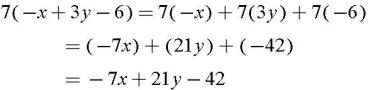
Applying the distributive property to each term in the parentheses gives


Notice that the operation before each term to be multiplied is treated as a sign.

Thus, the number 7 is multiplied by each of the terms, ? x, + 3 y, and ? 6, as shown. Each product is separated by addition. Then the operation and sign are again combined using rules of signed number multiplication to give the final answer.

In this example, no combining of like terms was possible because all of the terms...

UNLIMITED FREE
ACCESS
TO THE WORLD'S BEST IDEAS

SUBMIT
Already a GlobalSpec user? Log in.

This is embarrasing...

An error occurred while processing the form. Please try again in a few minutes.

Customize Your GlobalSpec Experience

Category: Complex Programmable Logic Devices (CPLD)
Finish!
Privacy Policy

This is embarrasing...

An error occurred while processing the form. Please try again in a few minutes.