Technical Shop Mathematics, Third Edition

Trigonometry is a most useful tool in the shop and in the drafting room. Many parts that are designed and produced involve angles or angular relationships. Trigonometry is needed to design these parts, to set them up on machine tools, to fabricate jigs and fixtures on which the parts are made, and to measure them after machining. The objective of this chapter is to provide examples and problems of typical shop and design room situations where trigonometry is used.
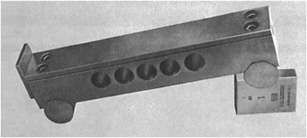
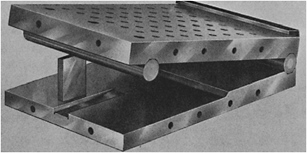
A typical sine bar and sine plate are shown in Figures 22.1A and 22.1B. These precision tools are used in tool and die shops to make precise angular measurements and to hold workpieces in precise angular relationships on machine tools such as jig borers, jig grinders, and surface grinders. When the angle to be machined or measured has a limit of accuracy of 0.1 (6 minutes) or less, sine bars and sine plates are almost indispensable tools.
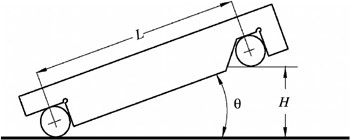
These tools are precision-ground on all surfaces. As shown in Figure 22.2, two cylindrical rolls having equal diameters are attached to each end of these tools so that they are parallel and held at a precise distance L usually 5, 10, or 20 inches apart in the English system, and 100 or 200 mm apart in the metric system.
The measure of angle ? is obtained by the distance